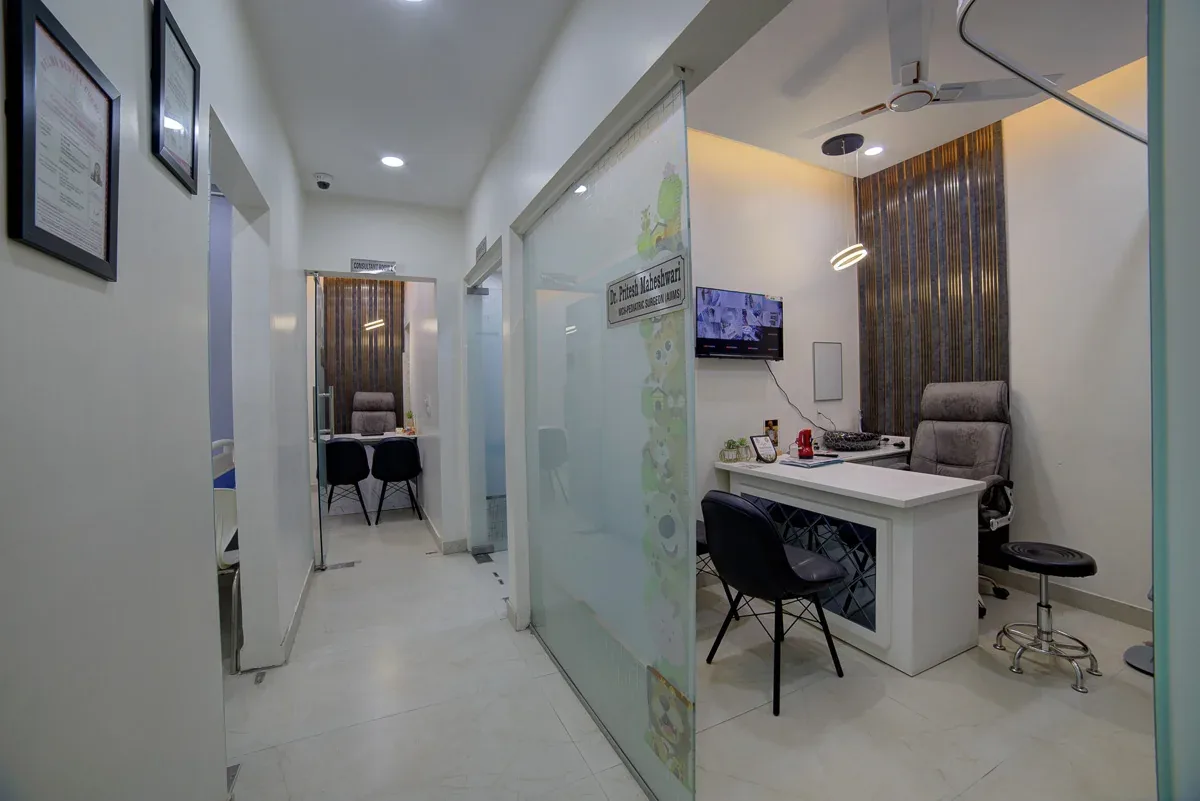
Dr. Pritesh Maheshwari is an AIIMS-trained pediatric surgeon and pediatric urologist in Delhi. He assesses boys with hypospadias, explains every option clearly, and plans surgery only when your child needs it.
Learning that your son has hypospadias can feel worrying, especially in the first weeks after birth. The good news is that it is a well-understood condition, and with careful assessment and a planned repair, most children recover well and grow up without lasting problems.
As a hypospadias surgeon in Delhi, Dr. Pritesh Maheshwari sees children from birth through adolescence at Maheshwari Multispeciality Clinic, Delhi, as part of his pediatric urology practice. Every child is examined in person, parents are given a clear explanation of what was found, and the treatment plan is built around that individual child.
Hypospadias is a condition present at birth in which the opening of the urethra (the tube that carries urine out of the body) sits on the underside of the penis instead of at the tip. It happens when the urethra doesn’t fully form during pregnancy. It is one of the more common birth differences seen in boys, and it is not caused by anything parents did or did not do.
Hypospadias is grouped by where the opening sits:
The opening is near the head of the penis. This is the most common and usually the simplest to repair.
The opening is along the middle of the shaft.
The opening is near the base of the penis, on the scrotum or below it. These cases often have more curvature and may need a staged repair.
If you notice any of these, a specialist consultation is the right next step.
Book a ConsultationPlease avoid circumcision until your child has been assessed, because the foreskin is often used to rebuild the urethra during repair.
Hypospadias repair aims to help your child pass urine standing up with a straight stream, to straighten the penis so it works normally in adult life, and to give it a natural appearance. Surgery is done under general anaesthesia, and the plan depends on the type and severity.
Most distal and many midshaft cases can be corrected in one operation. The urethra is extended to the tip, any curvature is corrected, and the skin is reshaped. Tubularised incised plate (TIP) repair is one widely used technique for these cases.
Proximal hypospadias with marked curvature is often repaired in two operations, usually several months apart. The first straightens the penis and prepares tissue; the second builds the new urethra.
Some children need further surgery for a fistula (a small leak along the repair) or narrowing of the opening. These are assessed and planned individually.
Repair is commonly planned between 6 and 18 months of age, before toilet training and before a child remembers the experience. Very mild cases, with a straight penis and a normal stream, may not need surgery at all. Dr. Pritesh will advise on timing after examining your child.
A Senior Consultant Pediatric Surgeon and Pediatric Urologist with more than a decade of surgical experience. He performs hypospadias repair as part of his pediatric urology practice.
Hypospadias is usually diagnosed by examination, often by the paediatrician soon after birth. At the consultation, Dr. Pritesh examines the position of the opening, the degree of curvature, the foreskin, and both testes. He also asks about how your child passes urine.
Most children with distal hypospadias need no further tests. When the opening is far back, or a testis cannot be felt, additional evaluation may be advised before surgery is planned.
You will leave the first visit knowing what type of hypospadias your child has and what the options are.
Like any surgery, hypospadias repair carries risks. These include bleeding, infection, a fistula, narrowing of the urethra or its opening, wound breakdown, and some remaining curvature. Some children need a second procedure. Dr. Pritesh will explain the risks that apply to your child before you decide.
Many children go home the same day or the next day. A small catheter or stent usually stays in place for several days to protect the repair, and a dressing covers the penis. You will be shown how to manage the catheter and nappies, give pain relief, and keep your child comfortable. Swelling and some bruising are normal at first.
The dressing and catheter are removed at a planned review. Further visits check healing, the urine stream, and the final result. Children with proximal hypospadias are usually followed up for longer, as they grow.
When to call the clinic: call promptly if your child has a fever, cannot pass urine, has heavy bleeding, the catheter falls out early, or the area becomes very red, swollen, or painful.
Hypospadias repair is delicate reconstructive work on small tissues. A pediatric surgery and pediatric urology specialist is trained specifically in children’s anatomy, in operating on infants, and in working with pediatric anaesthesia teams. Just as important, the whole visit, from examination to aftercare, is built around children and their parents.
Many parents begin by searching for the best hypospadias surgeon in Delhi. A more useful question is which surgeon is right for your child. Look for specialist pediatric training, regular experience with hypospadias repair, clear explanation of the plan and its risks, and dependable follow-up after surgery.
If you are searching for a hypospadias surgeon near you in East Delhi, Dr. Pritesh consults at Maheshwari Multispeciality Clinic on Delhi Main Road, near Rattan Devi School.
For families across the NCR, Dr. Pritesh also serves as Head of Pediatric Surgery at Yashoda Hospital, Kaushambi, and as a visiting consultant at hospitals including Max Hospital, Vaishali, and Sarvodaya Hospital, Noida. The clinic team can advise where your child’s surgery will take place.
Bring any previous reports or discharge summaries, and a note of your questions. If your child has not been circumcised, please keep it that way until after the consultation.











Every child with hypospadias is different, and so is every repair. Book a consultation with Dr. Pritesh Maheshwari for a careful assessment and a plan you understand.